AI Agent Marketplace: How to Find Tools That Work
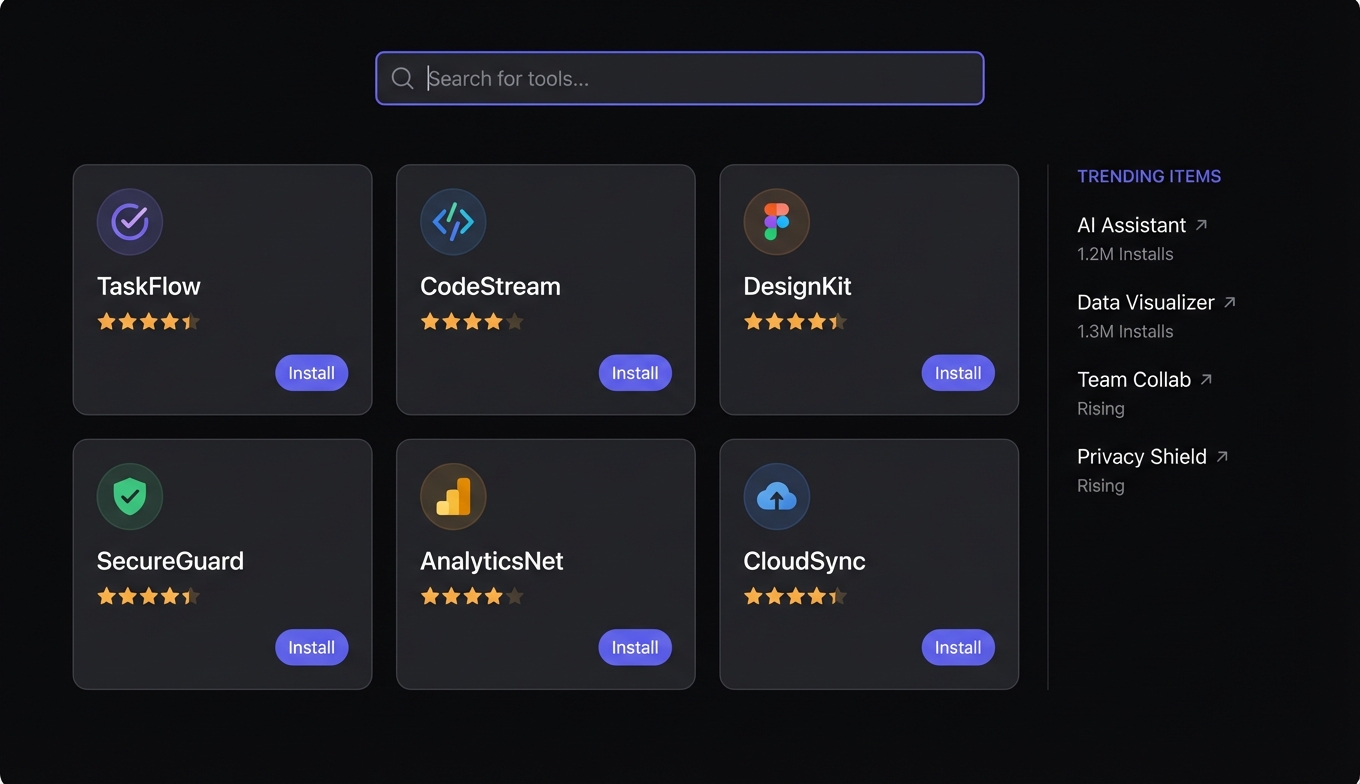
Over 10,000 MCP servers. 120+ distinct tool categories. A market that hit $7.63 billion last year and is projected at $10.91 billion this year.
The problem isn't a lack of tools — it's finding the right ones without wasting a week evaluating options that look good in a README and fall apart in production.
That's what a marketplace is supposed to solve. This guide breaks down what to look for, how the current options compare, and which tools are worth installing today.
What Is an AI Agent Marketplace and Why It Matters
An agent marketplace is a curated directory where developers discover, evaluate, and install tools for AI agents — MCP servers, skills, integrations, and workflows. Think of it as an app store, but for the capabilities you plug into Claude Code, OpenClaw, Cursor, or any other agent framework.
Why does this matter now? Because the ecosystem's complexity has crossed a threshold.
When MCP launched in November 2024, there were a handful of servers. Fourteen months later, there are 10,000+. Gartner reports that multi-agent system inquiries surged 1,445% from Q1 2024 to Q2 2025. 40% of enterprise applications are expected to embed AI agents by the end of 2026.
Without a marketplace layer, developers face the N×M integration problem directly. Every tool needs to be found, evaluated, configured, and maintained individually. An tool directory centralizes that work — someone else has already tested compatibility, documented the setup, and flagged the gotchas.
The parallel to mobile app stores is instructive. Before the App Store, finding software for your phone meant trawling forums and sideloading packages. The marketplace didn't create the software — it made discovering and trusting it practical at scale.
The Problem with Finding AI Agent Tools Today
If you've tried to find MCP servers for a specific use case, you know the pain. The current discovery experience has several gaps:
Fragmented sources
Tools are scattered across GitHub repositories, npm packages, PyPI, blog posts, and Discord channels. There's no single place to search "I need an MCP server that does email verification" and get a ranked list of options with compatibility data.
No quality signals
GitHub stars tell you about popularity, not reliability. A server with 5,000 stars might have been abandoned six months ago. A server with 50 stars might be rock-solid and actively maintained. Without installation counts, user reviews, and compatibility testing, you're guessing.
Configuration friction
Even after finding a tool, getting it running often means reading through scattered docs, figuring out environment variables, and debugging connection issues. Every tool has its own setup story, and few of them are short. (We wrote step-by-step setup guides for Tavily and Apify specifically because their official docs left too many gaps.)
Compatibility uncertainty
Does this MCP server work with Claude Code? OpenClaw? Cursor? What about the latest protocol version? Most tool READMEs don't answer these questions explicitly, which means you find out the hard way — after spending time on installation.
Composio (25,000+ GitHub stars, $25M Series A) has tried to solve parts of this with 10,000+ tool integrations. Smithery pioneered the MCP server marketplace concept with 7,300+ catalogued servers. But the market still lacks a focused skills marketplace that combines curation, testing, and one-click installation for the tools developers actually need.
What to Look for in an AI Agent Marketplace
Not all directories are created equal. Here's what separates a useful tool marketplace from a glorified link dump:
Compatibility testing
The marketplace should verify that listed tools actually work with specific agent frameworks. "Supports MCP" is necessary but not sufficient — you need to know it works with your setup.
Curation over volume
10,000 untested servers is less useful than 200 tested ones. The best marketplaces actively evaluate tools rather than auto-indexing every GitHub repository that mentions MCP.
Installation paths
A good marketplace reduces setup to a config snippet or a single command. The fewer steps between "I found this tool" and "my agent can use it," the better.
Real usage data
Installation counts, active user numbers, update frequency, and community feedback. These signals help you distinguish maintained tools from abandoned experiments.
Category organization
Tools should be organized by what they do (search, email, data, scraping) rather than just by protocol or framework. You're searching for capabilities, not implementation details.
Comparing the Top AI Agent Marketplaces in 2026
Here's how the current options stack up across the dimensions that matter:
| Feature | Smithery | Composio | ClawsMarket | GitHub Search |
|---|---|---|---|---|
| Total tools listed | 7,300+ MCP servers | 10,000+ integrations | Curated catalog | Unlimited (uncurated) |
| Curation approach | Indexed, light review | Managed connectors | Hand-tested, scored | None |
| Framework compatibility | MCP-focused | Multi-framework | MCP + skills | Varies per repo |
| Install experience | Config snippets | SDK integration | Config + one-click | Manual |
| Quality signals | Basic metadata | Usage stats | Scores + reviews | Stars only |
| Category depth | Broad | Very broad | Focused on dev workflows | N/A |
| Free tier | Yes | Yes (limited) | Yes | Yes |
| MCP-native | Yes | Yes | Yes | Varies |
Smithery
The pioneer of the MCP server marketplace concept. Smithery's strength is breadth — if an MCP server exists, Smithery has probably indexed it. The tradeoff is that curation is light. You'll find what you're looking for, but you'll need to do your own evaluation of quality and compatibility. Good for exploration, less ideal when you need a vetted recommendation.
Composio
Composio takes a managed approach: rather than indexing external servers, they build and maintain integrations themselves. The result is 10,000+ tool connections that are more standardized but also more tightly coupled to Composio's SDK. Strong if you're building within their ecosystem, less useful if you want raw MCP servers for an existing setup.
ClawsMarket
Full disclosure: this is us. ClawsMarket focuses on curated, tested tools with compatibility scores and installation paths for OpenClaw, Claude Code, and other agent frameworks. The catalog is smaller than Smithery's, but every tool has been evaluated for reliability, documentation quality, and real-world usefulness. We prioritize depth over breadth.
GitHub search
Still where many developers start — and often where they end up frustrated. GitHub has everything, but finding the right MCP server means sifting through abandoned repos, demo projects, and tools that were last updated eight months ago. No quality signals beyond stars, no compatibility information, no installation guidance.
Tools Worth Installing Right Now
Rather than listing everything, here are three tools from different categories that consistently deliver value in production agent workflows:
For web scraping and automation
Apify gives your agent the ability to scrape websites, extract structured data, and automate browser interactions. With thousands of pre-built "actors" for common sites and a robust MCP server, it handles the use cases where APIs don't exist. If your agent ever needs to pull data from a website, Apify is the tool that saves you from writing custom scrapers.
For agent-native email
AgentMail is built specifically for AI agents that need to send, receive, and manage email. Not a marketing email platform retrofitted with an API — a tool designed from the ground up for conversational email workflows. Your agent can handle customer inquiries, send follow-ups, and manage threads as part of a larger pipeline.
For market and trend analysis
Google Trends exposes search interest data to your agent, enabling workflows around content strategy, market research, and competitive analysis. Pair it with a search tool like Tavily and a data source like FRED, and you have a research pipeline that grounds its analysis in real trend data rather than LLM intuition.
All three are available on ClawsMarket with tested configurations and documented setup steps. Browse the full catalog to find tools for your specific workflow.
The Verdict
The agent marketplace space is still maturing. No single platform has definitively solved tool discovery for AI agents the way the App Store solved it for mobile. But the options have gotten dramatically better in the last twelve months.
If you need breadth: Start with Smithery. Its 7,300+ server catalog is the most comprehensive index of MCP tools available. Use it for exploration and initial research.
If you want managed integrations: Composio's approach of building and maintaining connectors in-house offers more consistency, especially if you're using their SDK. Best for teams that want a single vendor for their tool integration layer.
If you want curated, tested tools: ClawsMarket focuses on quality over quantity. Every tool is scored and tested for compatibility with major agent frameworks. Best for developers who'd rather install three tools that work than evaluate thirty that might.
If you're just exploring: GitHub search is free and unlimited. Just budget extra time for evaluation and setup.
The market is moving fast — Gartner's 1,445% surge in multi-agent inquiries translates directly into tool demand. Whatever marketplace you use, the important thing is to use one. The days of manually assembling an agent tool stack from scattered GitHub repos are ending, and the developers who adopt better discovery workflows will ship better agents.
For a companion comparison focused on directories rather than marketplaces, see our AI agent tool directory guide. And once you've found your tools, our guide on building production AI agent workflows covers how to wire them together reliably.
Frequently Asked Questions
What is an AI agent marketplace?
An AI agent marketplace is a platform where developers discover, evaluate, and install tools for AI agents. These tools include MCP servers (external capabilities that connect via the Model Context Protocol), agent skills (native plugins for specific frameworks), and pre-built workflows. Think of it as an app store for AI agent capabilities — rather than searching GitHub and configuring tools manually, you browse a curated catalog with compatibility information, quality scores, and streamlined installation.
How many AI agent tools are available in 2026?
The ecosystem has grown rapidly. There are over 10,000 published MCP servers, with Smithery alone cataloguing 7,300+. Composio offers 10,000+ managed integrations. StackOne mapped 120+ distinct AI agent tools across categories in early 2026. The total number of available tools continues to grow as the AI agents market expands toward its projected $10.91 billion valuation this year — a 45%+ CAGR from 2025.
What's the difference between an MCP server marketplace and an AI agent skills marketplace?
An MCP server marketplace focuses specifically on tools that connect via the Model Context Protocol — the open standard for AI-tool connectivity. An skills marketplace is broader, including native framework plugins, workflow templates, and prompt libraries alongside MCP servers. In practice, most marketplaces are converging to cover both, since MCP has become the dominant standard for tool integration. ClawsMarket lists both MCP servers and framework-specific skills in a single catalog.
How do I evaluate AI agent tools before installing them?
Look for five signals: active maintenance (commits in the last 30 days), compatibility verification with your specific framework, documentation quality (especially configuration examples), community adoption (install counts over GitHub stars), and security posture (how credentials are handled). A good marketplace surfaces these signals for you. If you're evaluating tools directly on GitHub, check the issues tab for unresolved bugs and the release history for update frequency.
Are AI agent marketplaces free to use?
Most agent marketplaces offer free access to browse and discover tools. The tools themselves vary — many MCP servers are open-source and free, while the underlying services they connect to (search APIs, email platforms, data providers) may have their own pricing. Smithery, Composio, and ClawsMarket all offer free tiers. The marketplace layer generally doesn't add cost on top of whatever the tool's own pricing is.